Dr. Christopher (Risto) Filippi Interviewed by Dr. Abdullah Alqabbani
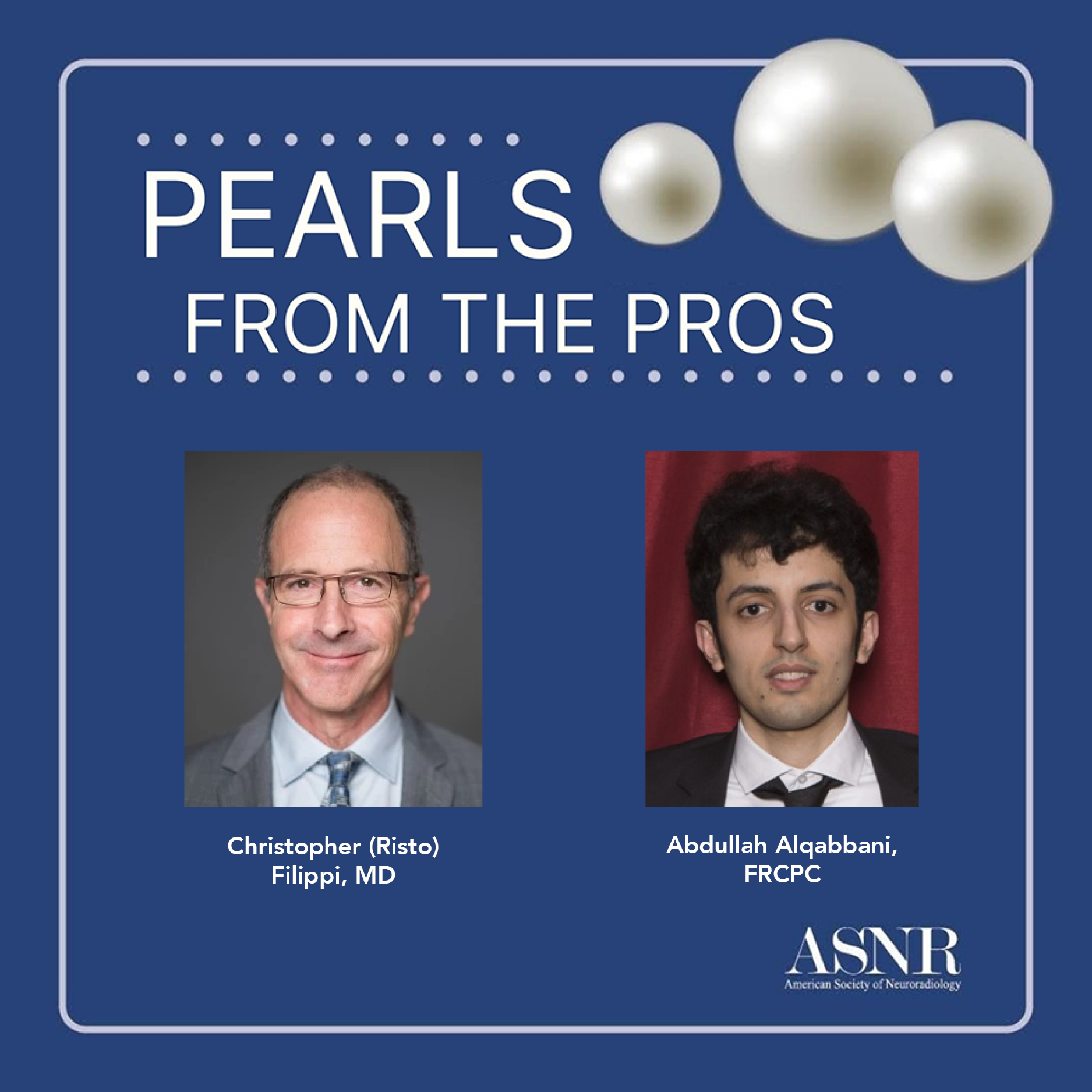
Dr. Christopher (Risto) Filippi is a pediatric neuroradiologist and the Division Chief of Pediatric Neuroradiology at The Hospital for Sick Children and a Senior Associate Research Scientist at the SickKids Research Institute in Toronto. Previously, he chaired the Department of Radiology at Tufts University.
Dr. Filippi was the inaugural Deputy Editor of AI then a Senior Editor for the American Journal of Neuroradiology, a past president of the American Society of Functional Neuroradiology and the Eastern Neuroradiology Society. He is currently the Vice Chair of the Pediatric MR Users Group for the International Society of Magnetic Resonance in Medicine and is a member of the Radiology Society of North America’s Scientific Advisory Panel. Dr. Filippi’s research interests include artificial intelligence (AI), diffusion MR contrast in normal brain development and disease states, quantitative MR, glymphatic flow, neuroinflammatory disorders, and translating advanced MR imaging techniques into routine clinical practice.
What are some of the important lessons you’ve learned from your presidency of the American Society of Functional Neuroradiology (ASFNR) and Eastern Neuroradiology Society (ENRS)?
It was, for me, a real privilege to have been a President for the Eastern Neuroradiology Society (ENRS) and the American Society of Functional Neuroradiology (ASFNR). Running a national meeting, the joy of choosing where I wanted it (Quebec City, Canada for ENRS and Portland, Oregon for ASFNR), creating intellectual content, and inviting speakers was a career highlight for me. Many leadership lessons unfold when you run a national meeting. You get really good, really quickly at organizing, setting priorities, and delegating authority to others because you cannot do this alone. When things go awry, and they will, you develop patience. You discover creative problem-solving skills that you did not know you had. Most important, perhaps, you learn over time how better to read people. Many will ask to volunteer for something but not everyone really comes through for you on time or when needed, which was a surprise to me. Good leaders inspire and create opportunities for others. One of my goals was to seek out new faces and encourage others to get involved. You want to leave the subspecialty society better than when you entered. All these skills translate to your academic job. For those seeking Chair positions, national leadership (i.e. leading an imaging society and running a national meeting) is helpful and noticed.
What do you wish you had known earlier in your career about successful leadership?
I wish that I had been more aware of the many kinds of leadership that exist and are possible. We tend to judge what is possible based on what we have experienced, and it can be hard to imagine a better kind of leadership. I trained at a time when many leaders were not particularly good listeners or empathic. Emotional intelligence was a non-concept. Anyone reading this can be a leader. First, you must want to lead and then you need to seek opportunities to lead. What has worked for me in my leadership roles relates to who I am, how I come across, and knowing my weaknesses and the areas in which I can improve. There are now many opportunities to learn more about leadership, such as the Radiology Leadership Institute of the American College of Radiology. Many business schools offer a two-week course on leadership that are highly worthwhile. My personal career trajectory would have benefitted from such courses earlier in my career. For the mid- to late-career radiologists, it is never too late to take advantage of these programs and to seek leadership opportunities. We need diverse leadership reflecting our membership and from all geographic locations from urban to rural.
Recognizing the variability across institutions, who are the key players in radiology departments that one should be aware of for academic advancement?
Every institution is its own unique ecosystem so the “key players” may vary. Most important, the metrics by which one can achieve advancement from assistant to associate and to full professor are highly variable depending on the academic institution. If your department has a Vice Chair for Academic Affairs or a Vice Chair for Education, those people should have a good idea about the specific criteria for promotion, and those criteria can be highly variable. In smaller academic practices, this may fall to the Division Chief. Knowing what is expected for promotions (number of paper publications, lectures given, committee involvement locally or nationally, hospital committees, etc.) can help you plan your career more carefully. Navigating an academic career and promotions is a fair amount of work. Seek a mentor for guidance within the department to help you. Some departments have established mentorship programs. If yours does not, I would choose a mentor whom you think has been successful and with whom you get along well. A kind and patient mentor may, in fact, be better than the more famous one. What I wish someone told me to do: keep track of every abstract, poster, paper, committee, etc. I was not as diligent as I should have been, and it is easy to lose track.
What are the most important factors in deciding on an academic position? And similarly, or private practice jobs?
This is like the Robert Frost poem about the two roads diverging in a yellow wood. This may be tempered by your family situation (spouse’s career, kids, etc.). If you want a more high-powered academic career, the prestige of the institution may matter and its resources, particularly if you seek more of a research pathway. If you want to be an outstanding educator, that prestige still may matter to you, and you may look for places where an educator is an academic leader either in that department or nationally. If you think that your primary focus will be that of a clinician, then the institutional prestige may matter less, but not always. For those with families or spouses, many of the choices will be determined by geographic preferences to be close to relatives or places where both can find jobs easily.
In private practice, you want to inquire about the path to partnership if that exists and what happens if you do not become a partner. You need to ask that group about its finances and its contractual agreement with the hospital network that they serve. Do they own their own equipment? Do they have a service that provides overnight coverage? You may not want to be up all-night reading cases. What is the retirement package? If you become a partner, what is the investment that you need to make (it can be a significant chunk of change).
Once decision is made, you need to have that contract scrutinized by a good lawyer. You want to know about your rights if your employer in academia wants to fire you. Most academics are on one-year contracts that are renewed annually, and most contracts have terms that allow a Chair to not renew a contract without cause (meaning you did nothing wrong, but the business plan has changed, and you are no longer needed). This happens more than you may imagine, and you have no legal recourse. You can try to add that you want “x “number of months of pay if this were to happen. Make sure that the malpractice insurance has a “tail” that will continue to cover you if you are no longer working there. Furthermore, take a course on negotiation. Most radiologists are poor at this. Everything can be negotiated such as less salary for more vacation, and your pay is negotiable. Just ask. The worst that will happen is a “no”. If you are not good at this, take a few courses or watch an on-line tutorial or read one of the good books on how to negotiate.
What habits do you wish you had developed early in your career in balancing home life with work life, and what tips do you have for others?
Before you can address life work balance, you need to know what kind of career you want. What are your priorities? You may not have the luxury to be fully intentional in this decision. If you have a life partner, she or he has a voice in this. Managing children and/or elderly parents can add to the challenge. You need to be realistic and strategic. Time is a precious resource and needs to be factored into decision-making.
I wished that I had worked harder to create a “zone” between life and work. I do now. When I am home, no emails from work. No electronics an hour before bedtime, and I read non-radiological things in that hour. Create this space to recharge so you remain healthy and resilient. Fitness and personal health have always been a priority for me and should be for you. Warren Buffet when asked by someone on television the best advice that he could give to a young investor answered, “the best investment you can make is in your own health”. Your family depends on you to be at your best, physically and mentally, so that advice resonated with me, and I have prioritized that above my career frankly.
Realistically, how do you find time? Let us use my life as one example. For my wife, a UN diplomat, and I, it meant very tough choices. I fully supported her career so when she was sent to Nepal to work on the Maoist takeover or to Tokyo to manage UN media globally, my son joined her. I only saw them during vacations. When she was overseas, we hired local cleaning help and someone to make dinners, and family helped out, too. In the US, we always had cleaning help, and we always had either an older Japanese or Finnish relative living with us who did all the cooking and ran the house like the housewife we both wanted. We were not independently wealthy, but we made choices to put money there so that we could be “career happy”, manage life better, enjoy time as a family (dinners lasted a couple of hours), and still find time for fitness. And, we have only one child, another intentional choice. We could not have done this if we had a second child, nor would we have succeeded without the family help. So, that was our solution, but what worked for us may not be possible for others. It is just an example of how tough these choices can be.
Lastly, as we age, we will evolve. Priorities change. How we define life-work balance will shift. It means something very different to me now than at the start of my career. Seek advice from colleagues. Never be shy to ask about how they manage this, as we all share this struggle.
What do you foresee as the biggest challenges facing our profession in the near future?
Radiology, more than any other specialty of medicine, is at the forefront of technological innovation. From film to PACS to artificial intelligence, we radiologists embrace change. The physical exam of my 1980s medical school experience is now an ER imaging study. Supporting the academic mission more fully remains challenging and under threat. One enormous change that evolved during my career was the corporatization of academic medical centers (AMCs) that increasingly looked to radiology departments as their “cash cows” to fund all kinds of shortfalls from their healthcare systems so that increasingly, all that mattered to them was how many scans could be performed and how quickly. Increasingly, radiologists were at risk of becoming a commodity. The power of radiology chairs has significantly diminished over the past several decades, equity companies have bought out many private practices, and many academic funds and research time have been decimated.
The absence of protected academic time is a real issue. One should not need to have it paid for by a grant. In my opinion, two of the most important neuroradiology developments came from radiologists who had protected time, namely the FLAIR and DWI sequences. Those sequences have been life changing for neuroradiologists and patients (think CVA and MS), but in the current practice environment, I wonder and I worry (because I am neurotic) at the end of my career, if such advances will be made by radiologists.
This brings us to AI which will likely transform radiology. I doubt that I will recognize radiological practice in 10 to 15 years. It is unclear to me who will be the biggest beneficiary. Clearly, Nvidia at 5 billion and counting is a current winner. I want AI to be “augmented intelligence”, meaning make me a better radiologist. Anything that empowers us to do good work, improves workflow, reduces waitlists, helps patients and improves patient outcomes (not easy to do with AI but that is another issue entirely), I am all for it. Many current AI tools leave a bit to be desired and are not yet making many of us more efficient. For example, when AI reliably reads a true negative (TN) correctly, that will be amazing. Maybe, we may not need as many radiologists, so I can see a future where far fewer radiologists are needed, and we become data managers of the AI tools in our repertoires. We have a shortage currently and are not expanding programs so maybe this is inevitable.
Virtual radiology is here to stay. Many places allow entire divisions to operate remotely. On the one hand, this is great for those wishing to live in a more affordable or rural environment. Are there downsides? Many institutions have remote shifts in the evening and overnight. Many good research studies have shown that evening and overnight shift work, even for a short duration of six months, is an independent risk factor for healthcare problems including higher rates of cardiovascular disease and cancer and shorter life expectancy. Why would we encourage this? Even if one makes more money, is it worth the health risk? My fantasy solution: if we are really demanding 24/7 coverage, then let hospitals purchase an apartment in Syndey and people go work there their entire career reading overnight cases there during daylight hours.
Many people in academia enjoy working from home virtually, and almost all educational conferences, at least in Toronto, have a virtual option. I do like working from home, but I worry about the optics. When you are not in the hospital, you are out of sight, out of mind, and maybe replaceable? Anecdotally, some of my best research ideas came from discussions with clinicians in a faculty lounge or over coffee. It is no accident that in the past 20 years, in keeping with corporatization of AMCs that most places got rid of physician lounges (we needed that space to make more money nonsense).
When most resident teaching conferences have a virtual option, no one shows up. It is just me in a conference room, alone, talking to a bunch of folks on-line most of whom turn the video off. It is joyless. It is impossible for me to tell who is engaged. It is time to bring them back from the ether and physically into the room. I like to show cases and have fellows take them, but I need to see them –their face, their body language to gauge how they are doing with that case. Imprinting our professional behavior is part of training and endangered by the virtual reality we are embracing. With oral boards again, I would urge the cessation of the virtual option for conferences. It is time to come back in person.